DialedSpec may earn a sales commission from merchant links on this page at no extra cost to you. Read how DialedSpec earns affiliate commissions
Whether you are refining high-contrast latte art or stretching whole milk for a silky flat white, the geometry, thermal responsiveness, and ergonomics of your steaming pitcher directly dictate your microfoam texture.
The Anatomy of an Effective Steaming Pitcher
A milk frothing pitcher is not merely a vessel; it is an active tool in fluid dynamics. When steam exits the wand tip at high pressure, the interior contours of the pitcher guide the milk into a continuous rolling vortex. This vortex breaks large air bubbles down into sub-millimeter microfoam and evenly integrates the milk fats and proteins.
- Spout Geometry: Round spouts create wide, bold patterns (hearts, tulips), whereas sharp, pointed spouts provide the narrow flow rate needed for intricate rosettas and high-definition wing lines.
- Volume Matching: A pitcher should be filled roughly one-third to one-half full before stretching to allow sufficient headroom for expansion and vortex generation.
- Wall Material: Food-grade 304 stainless steel remains the industry benchmark due to its rapid heat transfer, hygiene, and durability under repeated thermal cycles.
Featured Pitchers for Home and Barista Workflows
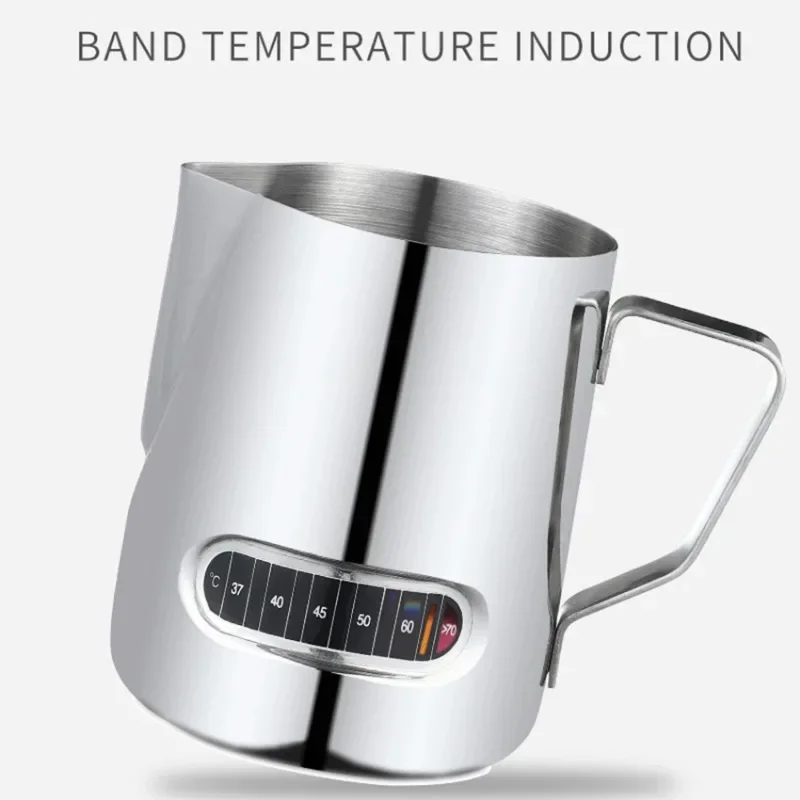
1. Best for Temperature Consistency: 350mL Pitcher with Integrated Indicator
Achieving the ideal milk temperature—between 60°C and 65°C (140°F–150°F)—is critical. At this threshold, lactose reaches perceived peak sweetness without denaturing whey proteins or scalding. While traditional clip-on probe thermometers often disrupt the circular vortex in smaller 350mL jugs, an integrated thermochromic band provides real-time thermal feedback directly through the stainless steel wall.
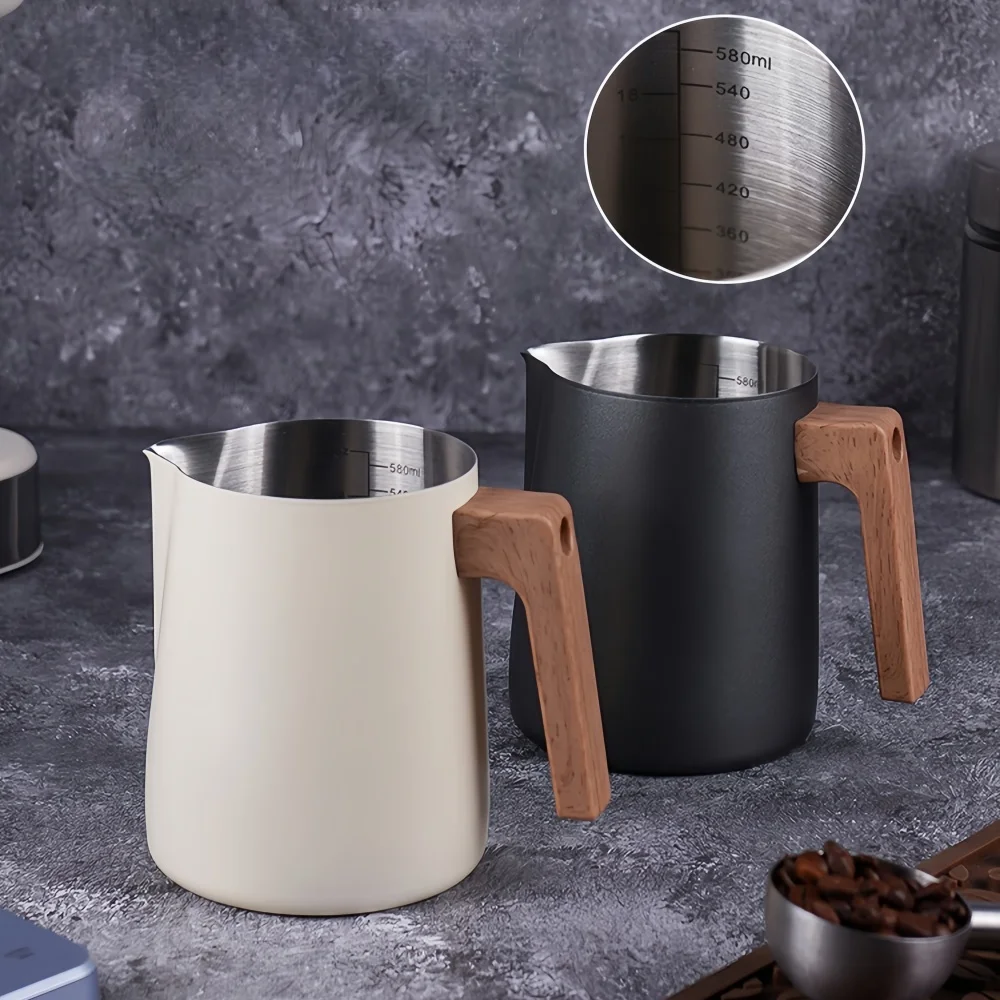
2. Best for Ergonomics & Dosing Control: Wood-Grain Handle Pitcher with Scale
Repeated steaming cycles can cause bare stainless handles to become uncomfortably warm. Pitchers with insulated or composite wood-grain handles mitigate thermal transfer, allowing a secure, relaxed grip during delicate pours. Internal volume measurement lines remove the guesswork from dosing, reducing milk waste across varied drink sizes.
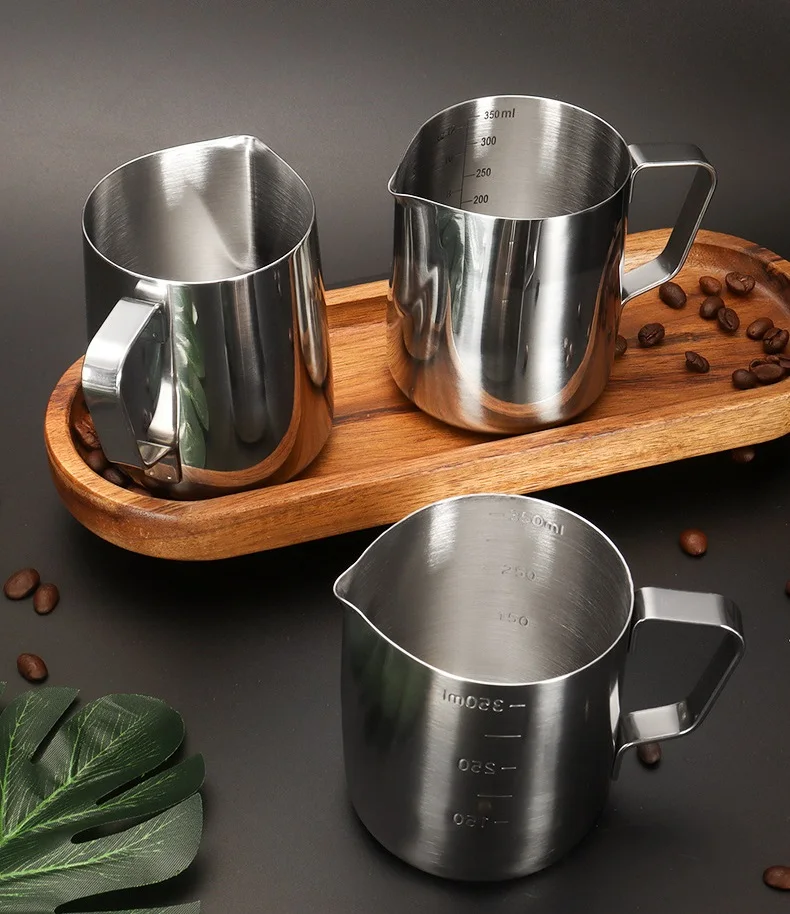
3. Best for Intricate Latte Art: Gradated Sharp-Spout Pitcher
For baristas prioritizing complex free-pour designs like winged tulips and rosettas, spout taper is paramount. A pointed, sharp spout constricts the liquid stream, providing precise control over the pour's velocity and landing point on the espresso crema. Internal graduation marks assist in maintaining accurate milk ratios for standard 6 oz to 10 oz cups.
Pitcher Sizing & Spout Selection Matrix
| Feature / Type | Sharp Spout | Round Spout | Temp-Strip Body |
|---|---|---|---|
| Primary Strength | Fine-line definition and detail work | Broad symmetrical base shapes | Real-time temperature feedback |
| Ideal Beverage | Flat Whites, Cortados, Macchiatos | Cappuccinos, Traditional Lattes | All milk beverages (training phase) |
| Barista Skill Level | Intermediate to Advanced | Beginner to Intermediate | Beginner to Intermediate |
Care and Maintenance Recommendations
To preserve stainless steel surfaces and avoid milk stone accumulation, rinse your pitcher immediately after every steaming cycle with cold water. Avoid abrasive metal scouring pads on pitchers with exterior coatings, scale etchings, or external thermal indicators. Periodic soaking in a dedicated espresso machine milk-line detergent will break down residual dairy fats and maintain clean interior measurement markings.